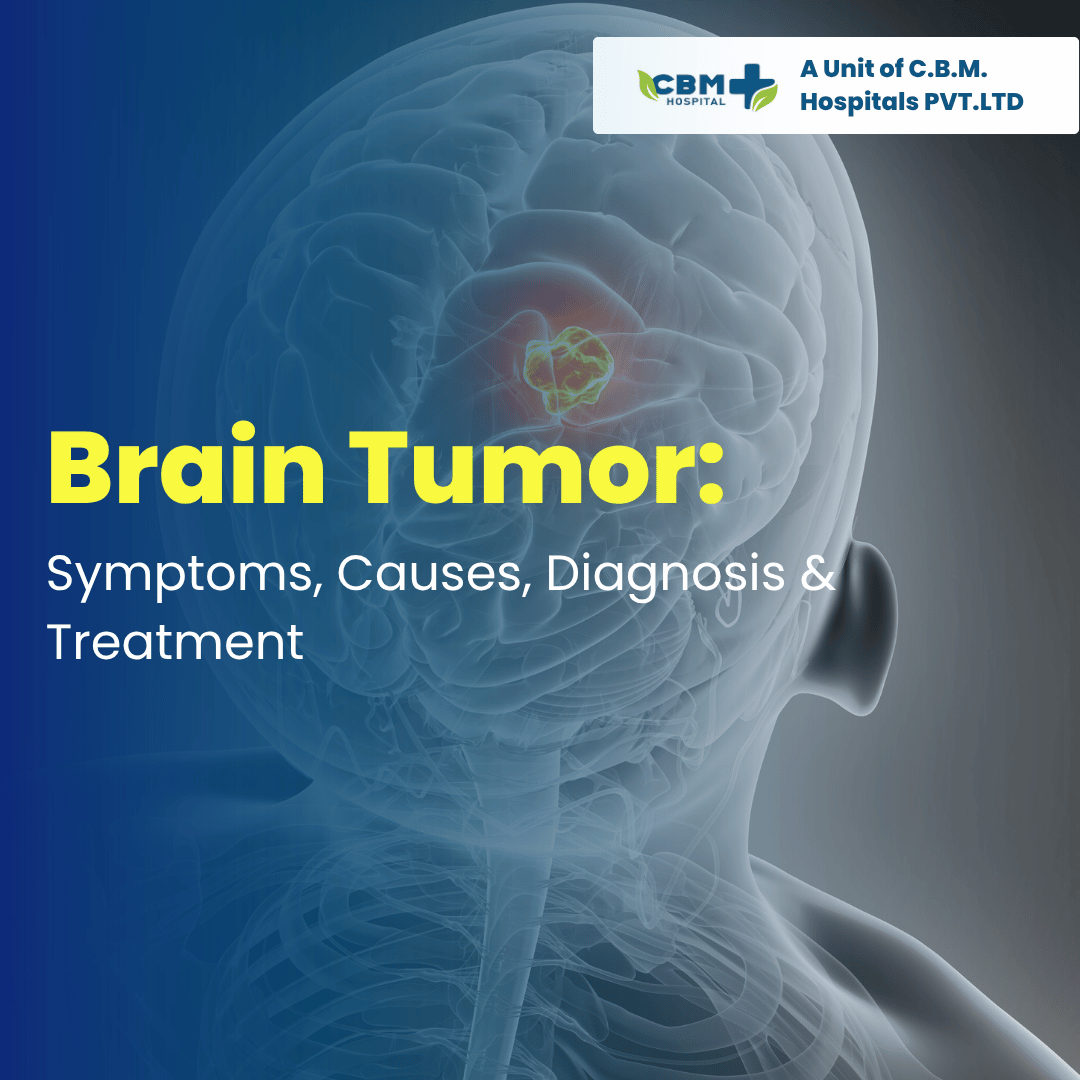
A brain tumor is an abnormal growth of cells in or around the brain. Brain tumors can be benign (non-cancerous) or malignant (cancerous). They can develop in different parts of the brain and may affect important functions such as movement, speech, memory, vision, balance, and coordination.
Some brain tumors grow slowly, while others may grow more quickly. Symptoms depend on the tumor’s size, location, and type. Early medical evaluation is important when persistent or unusual neurological symptoms develop.
This blog explains the symptoms, causes, types, diagnosis, treatment options, and recovery associated with brain tumors.
What Is a Brain Tumor?
A brain tumor develops when cells grow abnormally and form a mass within the brain or nearby structures.
Brain tumors are broadly classified into:
Benign Brain Tumors
Benign tumors are generally non-cancerous and may grow slowly. However, they can still cause serious problems if they press on important areas of the brain or increase pressure inside the skull.
Malignant Brain Tumors
Malignant tumors are cancerous and may grow more aggressively. Some can invade nearby brain tissue or spread within the central nervous system.
Brain tumors can also be classified as primary or secondary (metastatic).
- Primary brain tumors begin in the brain or nearby tissues.
- Secondary brain tumors occur when cancer from another part of the body spreads to the brain.
In many cases, the exact cause of a brain tumor is not known.
Possible risk factors or associations may include:
- Certain genetic conditions
- Previous exposure to high-dose radiation to the head
- Family history of certain brain tumors
- Changes or mutations in specific genes
- A history of cancer elsewhere in the body, which can spread to the brain
It is important to understand that having a risk factor does not necessarily mean that a person will develop a brain tumor.
Types of Brain Tumors
There are many types of brain tumors.
Some commonly known types include:
- Gliomas
- Glioblastoma
- Meningioma
- Pituitary tumors
- Schwannomas
- Medulloblastomas
- Metastatic brain tumors
The treatment depends greatly on the type, grade, location, and size of the tumor.
Symptoms of a Brain Tumor
Brain tumor symptoms vary from person to person. Some symptoms develop gradually, while others may appear more quickly.
Common symptoms may include:
- Persistent or worsening headaches
- Nausea or vomiting
- Seizures
- Blurred or double vision
- Difficulty speaking
- Weakness or numbness
- Problems with balance or coordination
- Memory problems
- Changes in personality or behaviour
- Difficulty concentrating
- Excessive sleepiness
- Changes in hearing
- Difficulty walking
Having one of these symptoms does not automatically mean that a person has a brain tumor. Many other medical conditions can cause similar symptoms.
Headache and Brain Tumors
Headaches are common and usually have many possible causes.
A headache associated with a brain tumor may sometimes:
- Become progressively worse
- Be different from previous headaches
- Be accompanied by vomiting
- Occur along with neurological symptoms
- Be worse in the morning in some patients
However, headache alone is usually not enough to diagnose a brain tumor.
Seizures
A seizure can sometimes be the first noticeable symptom of a brain tumor.
A person may experience:
- Uncontrolled movements
- Temporary loss of awareness
- Staring episodes
- Abnormal sensations
- Confusion after the episode
A first-time seizure requires medical evaluation.
Warning Signs That Need Medical Attention
Seek prompt medical attention if a person develops:
- A new or rapidly worsening headache
- A first-time seizure
- Sudden weakness or numbness
- New difficulty speaking
- Significant vision changes
- Increasing confusion
- Repeated unexplained vomiting
- Progressive problems with balance or walking
- Significant changes in behaviour or personality
Sudden symptoms such as facial drooping, arm weakness, speech difficulty, or loss of consciousness can also indicate other medical emergencies, such as stroke, and require immediate emergency care.
How Is a Brain Tumor Diagnosed?
Doctors use several tests to determine whether a brain tumor is present and to understand its characteristics.
Neurological Examination
A doctor may evaluate:
- Muscle strength
- Reflexes
- Vision
- Eye movements
- Balance
- Coordination
- Memory
- Speech
- Sensation
The examination helps identify which parts of the nervous system may be affected.
MRI Scan
An MRI of the brain is one of the most important imaging tests for evaluating suspected brain tumors.
It can provide detailed information about:
- Tumor location
- Tumor size
- Surrounding brain tissue
- Possible swelling
- Relationship to important brain structures
Contrast material may be used in some MRI examinations.
CT Scan
A CT scan can provide rapid images of the brain and may be particularly useful in emergency situations or when MRI is not suitable.
Biopsy
In some cases, a biopsy may be required to determine the exact type and grade of a tumor.
A small sample of tissue is examined by a pathologist. The results can help doctors decide which treatment is most appropriate.
Not every brain tumor requires a biopsy; the decision depends on the location and characteristics of the tumor.
Brain Tumor Treatment
Treatment depends on several factors, including:
- Type of tumor
- Grade
- Size
- Location
- Growth rate
- Symptoms
- Patient’s age and general health
- Whether the tumor has spread
Treatment may involve one or more approaches.
1. Observation and Regular Monitoring
Some slow-growing tumors that are not causing significant symptoms may be monitored with regular MRI scans and medical follow-up.
This approach is sometimes called active surveillance or watchful waiting.
2. Brain Tumor Surgery
Surgery may be recommended when the tumor can be safely removed or when tissue is needed for diagnosis.
The main goals may include:
- Removing as much of the tumor as safely possible
- Reducing pressure on the brain
- Relieving symptoms
- Obtaining tissue for diagnosis
The exact surgical approach depends on the tumor’s location and characteristics.
Craniotomy
A craniotomy involves temporarily removing a section of the skull to provide access to the brain.
The surgeon removes or treats the tumor through this opening and then replaces the bone section.
Minimally Invasive or Image-Guided Approaches
For selected tumors, surgeons may use specialised techniques, navigation systems, or minimally invasive approaches to access the tumor while aiming to protect healthy brain tissue.
Not every tumor is suitable for the same surgical technique.
3. Radiation Therapy
Radiation therapy uses high-energy radiation to damage tumor cells.
It may be recommended:
- After surgery
- Instead of surgery in selected cases
- For tumors that cannot be completely removed
- To treat certain metastatic brain tumors
The type and dose depend on the specific tumor.
4. Chemotherapy and Other Medicines
Certain brain tumors may respond to chemotherapy or other drug treatments.
Depending on the tumor type, doctors may also use:
- Steroids to reduce brain swelling
- Anti-seizure medicines for patients who experience seizures
- Targeted therapies
- Other specialised treatments
Treatment is tailored to the individual patient.
Can a Brain Tumor Be Cured?
There is no single answer because brain tumors are very different from one another.
Some benign tumors can be successfully removed or controlled. Some malignant tumors can also be treated effectively, while others may require long-term treatment and monitoring.
The prognosis depends on factors such as tumor type, grade, location, size, molecular characteristics, response to treatment, and overall health.
The treating neurosurgeon and oncology team can provide a more accurate assessment after diagnosis.
Recovery After Brain Tumor Treatment
Recovery depends on the type of tumor and treatment received.
After surgery, patients may need monitoring of:
- Consciousness
- Speech
- Vision
- Movement
- Muscle strength
- Balance
- Seizures
- Wound healing
Some patients may need rehabilitation after treatment.
Rehabilitation May Include
- Physiotherapy
- Occupational therapy
- Speech therapy
- Cognitive rehabilitation
Recovery may take weeks or months depending on the individual situation.
Patients should attend follow-up appointments and undergo recommended imaging to monitor for tumor recurrence or progression.
Risks of Brain Tumor Surgery
Brain surgery is a major procedure and carries potential risks.
Possible complications may include:
- Bleeding
- Infection
- Brain swelling
- Seizures
- Neurological problems
- Changes in speech, movement, memory, or vision
- Cerebrospinal fluid leakage
- Blood clots
- Anaesthesia-related complications
- Tumor recurrence
The risks depend heavily on the tumor’s location and the type of surgery.
Can Brain Tumors Be Prevented?
Most brain tumors cannot currently be prevented because their exact causes are often unknown.
However, maintaining overall health and discussing significant risk factors with a doctor can be beneficial.
People who have received significant radiation exposure to the head or have certain inherited conditions may require appropriate medical follow-up.
Brain Tumor Treatment at Brij Lal Hospital
If a person develops persistent headaches, seizures, weakness, vision changes, balance problems, or other concerning neurological symptoms, timely medical evaluation is important.
At Brij Lal Hospital, patients can seek evaluation for neurological symptoms and discuss appropriate diagnostic and treatment options with qualified specialists. Depending on the condition, assessment may include neurological examination, imaging, specialist consultation, and treatment planning.
For patients searching for the Best Hospital in Haldwani for neurological evaluation and treatment, it is important to consider specialist expertise, diagnostic facilities, surgical support, emergency services, and follow-up care.
Brij Lal Hospital can also be considered by patients looking for a Best Multispeciality Hospital in Haldwani for comprehensive medical evaluation and treatment.
Frequently Asked Questions (FAQs)
1. What are the first symptoms of a brain tumor?
Possible symptoms include persistent headaches, seizures, vomiting, vision changes, weakness, balance problems, memory changes, and speech difficulties. Symptoms vary depending on the tumor’s location.
2. Is every brain tumor cancerous?
No. Some brain tumors are benign, while others are malignant. Even a benign tumor can cause serious problems if it presses on important areas of the brain.
3. Does every brain tumor require surgery?
No. Some tumors can be monitored, while others may require surgery, radiation therapy, medicines, or a combination of treatments.
4. Can a brain tumor cause headaches?
Yes, a brain tumor can cause headaches, but most headaches are caused by conditions other than brain tumors.
5. Is brain tumor surgery safe?
Brain tumor surgery can be performed safely in appropriate patients, but it is a complex procedure with potential risks. The risks depend on the tumor’s location, size, type, and the patient’s overall health.
6. How long does recovery take after brain tumor surgery?
Recovery varies widely. Some patients may return to normal activities relatively quickly, while others may need several weeks or months of rehabilitation.
7. Can a brain tumor come back after treatment?
Some tumors can recur after treatment, while others may have a low risk of recurrence. Regular follow-up and imaging are important.
Conclusion
A brain tumor is an abnormal growth of cells in or around the brain. It can be benign or malignant, and symptoms vary according to the tumor’s location, size, and growth rate.
Common symptoms may include persistent headaches, seizures, vision changes, weakness, balance problems, memory changes, and speech difficulties. Diagnosis may involve neurological examination, MRI or CT scans, and, in selected cases, a biopsy.
Treatment can include observation, surgery, radiation therapy, chemotherapy, targeted medicines, or a combination of treatments. Early evaluation of persistent or unusual neurological symptoms can help doctors identify the cause and plan appropriate treatment.
If you or a family member experiences concerning neurological symptoms, consult a qualified medical specialist for proper diagnosis and personalised treatment.